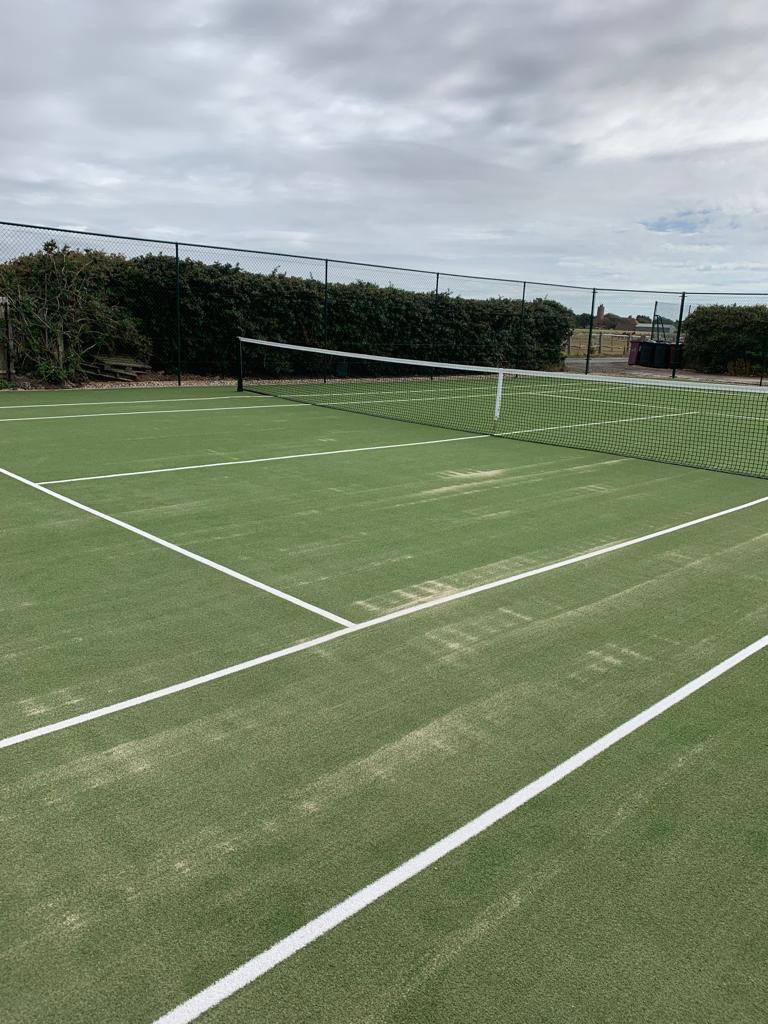
A tennis court may still look usable long after its surface has started to deteriorate. Faded coatings, minor cracks, worn playing areas and changes in surface texture can initially appear to be mainly cosmetic concerns. However, the condition of the playing surface has a direct influence on how a court feels and performs.
Consistent ball bounce, predictable movement and dependable grip all rely on a surface that remains in suitable condition. Once deterioration becomes established, players may begin adapting their movement or shots to compensate for areas of the court that behave differently.
For tennis court owners in Hampshire, UK, Tennis Court Construction Hampshire provides professional court construction and refurbishment services designed to restore both the appearance and playing characteristics of ageing courts.
Why Surface Condition Matters in Tennis
The court is an active part of every point played.
Each time the ball lands, the surface influences its bounce. Every change of direction places demands on the court’s texture and grip. Even relatively small variations can therefore become noticeable during regular play.
A good tennis surface should provide consistent characteristics across the playing area.
As the court deteriorates, variations can develop between heavily used and less frequently used sections, reducing that consistency.
An Uneven Surface Can Affect Ball Bounce
Predictable ball response is fundamental to enjoyable tennis.
Players naturally anticipate how the ball will behave after contacting the court. When the surface is consistent, they can position themselves and prepare their shots with confidence.
Deterioration can affect this predictability.
Problems such as:
- Surface irregularities
- Cracking
- Depressions
- Localised repairs
- Loose material
- Worn areas
can cause the ball to react differently depending on where it lands.
Even if the variation is relatively small, regular players may notice that certain areas no longer produce the same dependable response as the rest of the court.
Worn Areas Can Change How the Court Feels Underfoot
Tennis involves frequent acceleration, stopping and changes of direction.
The surface therefore needs to provide suitable and reasonably consistent characteristics underfoot.
As coatings and textured finishes wear, certain sections may begin feeling noticeably different from others. The effect is often greatest in heavily used playing zones.
Rather than concentrating entirely on the game, players may find themselves becoming more conscious of where they place their feet.
A professionally maintained surface helps provide a more consistent playing environment across the court.
Heavy-Use Areas Often Deteriorate First
Wear is rarely distributed perfectly evenly across a tennis court.
Some areas naturally receive more activity than others. Baseline zones, for example, can experience considerable repeated movement during regular play.
Entrances and frequently used access points can also show earlier deterioration.
Over time, this can create noticeable differences between various parts of the surface.
Signs may include:
- Fading
- Loss of texture
- Smoother patches
- Localised surface wear
- Small cracks
- Changes in colour or finish
These changes can provide useful early indications that refurbishment should be considered.
Cracks Can Affect More Than Appearance
A crack running across a tennis court immediately interrupts the uniform playing surface.
Small cracks may initially seem insignificant, particularly if they are away from the most heavily used areas. However, once deterioration progresses, cracks can become increasingly noticeable during play.
The important consideration is also what caused the cracking.
Surface cracking can sometimes relate to movement or deterioration beneath the visible finish. Simply treating what can be seen without understanding the underlying condition may therefore fail to provide a suitable long-term result.
Professional assessment can establish whether deterioration is limited to the surface or whether deeper construction requires attention.
Drainage Problems Can Affect Playing Quality
Water management is another important part of court performance.
A tennis court needs suitable levels and drainage characteristics so that rainfall can clear effectively.
Where depressions or other surface irregularities have developed, water may begin remaining in certain locations for longer than intended.
Persistent wet areas can interrupt court availability and may also highlight deterioration that deserves investigation.
If water repeatedly gathers in the same places, simply resurfacing the visible court without assessing the reason may leave the underlying problem unresolved.
Faded Colour Can Indicate Wider Surface Ageing
Colour fading by itself does not necessarily mean that a tennis court has become unsuitable for play.
However, substantial fading can be one indication that the surface has experienced prolonged exposure and use.
When fading appears alongside loss of texture, cracking or worn markings, it becomes more useful as part of the overall assessment of the court.
Refurbishment can restore the visual definition of the playing area while also addressing appropriate surface deterioration.
Clear Line Markings Matter During Play
Tennis court markings have an obvious practical purpose.
Players need to judge whether the ball has landed inside or outside the relevant playing area. If markings have become heavily faded or worn, these decisions can become more difficult.
Clear, accurately defined lines contribute to a professional playing environment and improve the overall presentation of the facility.
Where the wider court surface also requires attention, line marking can form part of a comprehensive refurbishment rather than being treated as an isolated cosmetic task.
Surface Problems Can Change Player Behaviour
One of the clearest signs of a deteriorating court is when players begin changing how they use it.
They may avoid a particular cracked area, become cautious when changing direction in one section or anticipate an inconsistent bounce from a known surface defect.
Once players are consciously compensating for the court, the surface is no longer providing the consistent environment it should.
The court should support the game rather than becoming something players have to work around.
Does a Worn Court Always Need Complete Replacement?
No.
Visible wear does not automatically mean that an entire tennis court needs rebuilding.
Where the underlying construction remains stable, refurbishment can often provide an effective way to restore a tired playing surface.
The appropriate work depends on the existing condition of the court and may involve attention to:
- Surface deterioration
- Suitable cracks
- Worn coatings
- Playing texture
- Court markings
- Localised defects
A detailed assessment should be carried out before deciding how extensive the work needs to be.
When Can Tennis Court Refurbishment Be Suitable?
Refurbishment can be particularly appropriate when the fundamental court structure remains serviceable but the playing surface has become tired.
The aim is to restore the court rather than unnecessarily reconstruct components that continue to perform correctly.
Before refurbishment, the court should be assessed for signs of deeper problems.
If defects are largely surface-related, renovation can significantly improve both appearance and playability.
Why the Condition Beneath the Surface Matters
The visible finish is only one part of a tennis court.
Its performance also depends on the construction beneath it.
If the base has become unstable or significant movement has occurred, surface-only work may not resolve recurring cracks or changes in level.
A professional inspection should therefore look for signs such as:
- Widespread cracking
- Settlement
- Uneven areas
- Recurring surface failure
- Persistent drainage problems
- Significant changes in court levels
Understanding what is happening beneath the playing surface helps determine whether refurbishment or more extensive reconstruction is appropriate.
Consistency Is More Important Than Appearance Alone
An attractive court is desirable, but good refurbishment should achieve more than simply making the surface look newer.
The main objective should be to create a court that performs consistently.
This means considering how the ball interacts with the surface, how players move across it and whether different parts of the playing area provide similar characteristics.
A freshly coloured surface that still contains underlying irregularities has not addressed the complete problem.
Professional refurbishment focuses on performance as well as presentation.
Early Refurbishment Can Help Preserve a Serviceable Court
Waiting until a court becomes severely deteriorated can allow smaller defects to become more established.
Periodic assessment makes it possible to identify deterioration while much of the existing construction remains serviceable.
Addressing suitable defects at the appropriate stage can help preserve the court and maintain a better standard of play.
Signs that an assessment may be worthwhile include:
- Increasingly visible cracks
- Noticeable surface wear
- Faded or deteriorating coatings
- Poorly defined markings
- Changes in surface texture
- Uneven ball response
- Water collecting in particular areas
The presence of one minor imperfection may not indicate a significant problem, but several developing symptoms can show that the court is approaching the point where refurbishment would be beneficial.
Refurbishment Can Improve the Overall Playing Experience
When a tired court is professionally restored, the improvement can be noticeable before the first point is even played.
A clean, clearly defined and consistent surface creates a much better first impression.
More importantly, appropriate refurbishment can help restore the playing qualities users expect from the court.
Players can concentrate on movement, positioning and shot selection rather than adapting to surface defects.
For private, shared or regularly used tennis courts, this can make the facility considerably more enjoyable to use.
Professional Tennis Court Refurbishment in Hampshire
At Tennis Court Construction Hampshire, we provide professional tennis court construction and refurbishment services throughout Hampshire, UK.
Our approach begins with assessing the existing court to understand whether deterioration is confined mainly to the playing surface or whether deeper issues also need attention. This allows the proposed work to address the actual condition of the facility rather than simply covering visible wear.
Where the underlying construction remains suitable, professional refurbishment can restore a worn court and significantly improve its appearance and playing characteristics. Where more substantial deterioration is identified, the appropriate level of remedial work can be determined before the new playing surface is completed.
Conclusion
A worn tennis court surface can affect the quality of play. Changes in texture, cracking, unevenness, faded markings and localised deterioration can all reduce the consistency players expect from the court. In particular, irregular ball bounce and differences in the surface underfoot can gradually make the court less enjoyable to use.
The good news is that a worn appearance does not automatically mean complete court replacement is necessary. Where the underlying construction remains stable, professional refurbishment can often restore a tired surface and provide a more consistent playing environment.
For tennis court owners in Hampshire, UK, Tennis Court Construction Hampshire provides professional court assessment, refurbishment and construction services. If your existing tennis court has become worn, cracked or inconsistent during play, contact our team to discuss its condition and determine the most appropriate way to restore its performance.
Call us on: 01264 312395
Click here to find out more about Tennis Court Construction Hampshire
Click here to complete our contact form and see how we can help with your courts needs.